
Industrial robots have gotten extra compact, extra succesful, and extra depending on electronics. A contemporary robotic system could mix servo drives, energy converters, movement controllers, sensors, and onboard computing {hardware} inside a restricted quantity of house.
Every part performs a unique perform, however they share one engineering problem: warmth.
For robotic producers and automation system integrators, thermal administration will not be merely a matter of stopping digital elements from overheating. It could affect gear reliability, packaging flexibility, upkeep necessities, and the flexibility to function persistently underneath demanding manufacturing circumstances.
The problem is especially vital in compact servo drives, sealed robotic controllers, and autonomous cell robots (AMRs), the place accessible house and cooling airflow could also be restricted.
A warmth sink that performs adequately on a laboratory bench could behave fairly otherwise after set up inside a densely packed industrial enclosure.
Why compact robotic methods create tough cooling circumstances
Conventional industrial automation methods usually separate energy electronics, management {hardware}, and mechanical gear into completely different assemblies. Compact robotic methods could convey many of those features nearer collectively.
Servo drives generate warmth by means of semiconductor switching and conduction losses. Energy provides and DC/DC converters introduce further losses, whereas processors, communication modules, and machine imaginative and prescient {hardware} contribute their very own thermal hundreds.
In an industrial management cupboard, these elements could share an elevated inner air temperature. In a cell robotic, they could be put in inside a comparatively small chassis with restricted air flow.
The ensuing problem will not be essentially an unusually excessive warmth load from one part. It’s the mixture of a number of warmth sources, restricted airflow, and restricted house for efficient warmth dissipation.
Engineers subsequently want to judge thermal efficiency on the system stage relatively than treating every digital part independently.
Begin with precise working circumstances, not simply rated energy
One of the vital vital distinctions in robotic thermal design is the distinction between electrical energy consumption and warmth dissipation.
A motor drive rated for substantial electrical output doesn’t convert all that energy into warmth. Its thermal load comes primarily from losses within the energy semiconductors and different elements.
These losses depend upon elements resembling working present, switching frequency, machine traits, and the robotic’s responsibility cycle.
A robotic arm performing intermittent pick-and-place operations could expertise repeated peaks in motor present adopted by intervals of decrease demand. A conveyor drive or repeatedly working servo system could produce a unique thermal profile.
For brief-duration hundreds, the thermal mass of the elements and warmth sink can quickly take in vitality. Nonetheless, this doesn’t eradicate the necessity to consider steady-state temperatures or repeated working cycles.
A helpful thermal design assessment ought to contemplate three circumstances:
- Peak loading: The utmost warmth technology throughout demanding actions or working occasions.
- Sustained loading: The losses related to steady operation over longer intervals.
- Repeated responsibility cycles: The temperature response when heating and cooling intervals happen repeatedly.
Probably the most demanding thermal situation will not be at all times the second of highest instantaneous electrical load.
Calculate the thermal finances earlier than selecting the warmth sink
Warmth sink choice ought to start with a temperature finances.
In a simplified steady-state evaluation, the allowable thermal resistance between the warmth sink base and the encircling cooling air could be estimated from the accessible temperature distinction and the warmth to be dissipated.
For instance, contemplate an illustrative motor-drive meeting with the next circumstances:
- Warmth dissipated into the warmth sink: 45 W
- Native cooling air temperature: 35°C
- Most permitted warmth sink base temperature: 65°C
The accessible temperature distinction is 30°C. Dividing this by the 45 W warmth load provides an allowable efficient base-to-air thermal resistance of roughly 0.67°C/W.
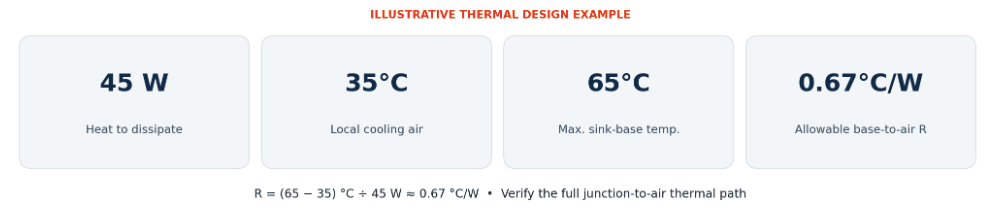
That is an illustrative first-pass calculation, not a whole thermal design.
The semiconductor junction temperature should nonetheless be evaluated by means of the whole thermal path, together with junction-to-case resistance, the thermal interface materials, and the warmth sink. Extra warmth sources, airflow restrictions, and transient habits additionally want consideration.
However, this method gives a extra significant place to begin than selecting a warmth sink solely by its exterior dimensions or fin rely.
A fan doesn’t assure efficient cooling
Pressured-air cooling is widespread in industrial electronics, however its effectiveness relies on the airflow that truly reaches the warmth sink.
A fan could have a formidable free-air airflow ranking. As soon as put in inside an enclosure, nevertheless, the airflow should cross by means of filters, air flow openings, cables, digital assemblies, and warmth sink fins.
Every restriction provides resistance to the airflow path.
Intently spaced fins can improve heat-transfer floor space, however they could additionally improve stress drop. If the chosen fan can’t present adequate stress, the extra fin space could ship little sensible profit.
This creates a tradeoff between fin density and accessible airflow.
For natural-convection methods, the state of affairs is completely different. With no fan, warmth elimination depends considerably on buoyancy-driven air motion. Fin orientation, channel spacing, and clearance across the warmth sink develop into particularly vital.
The identical warmth sink profile shouldn’t mechanically be thought-about appropriate for each passive and forced-air cooling.
Engineers also needs to contemplate how mud accumulation, partially blocked filters, or lowered fan efficiency could have an effect on the system throughout its working life.
For enclosed robots and industrial controllers, the related cooling setting is the air surrounding the warmth sink contained in the gear, not essentially the ambient temperature outdoors the machine.
The mounting floor is a part of the thermal design
Even a well-designed warmth sink can underperform if the mechanical interface with the ability module is insufficient.
Warmth should journey from the semiconductor package deal or module baseplate by means of the thermal interface and into the warmth sink.
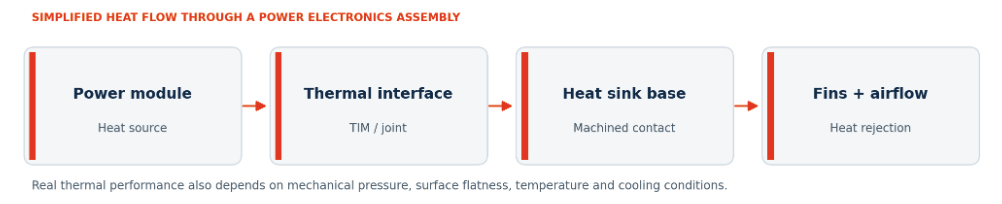
Small floor irregularities, extreme gaps, burrs, or inconsistent mounting stress can improve thermal resistance.
Thermal interface supplies assist fill microscopic gaps, however they shouldn’t be handled as an alternative choice to acceptable mechanical design.
For IGBT, MOSFET, and SiC energy modules, the required mounting-surface flatness, floor situation, and fastening methodology needs to be decided from the related module producer’s specs.
That is significantly vital for giant mounting areas and functions involving a number of energy modules on a typical cooling base.
From a producing perspective, aluminum extrusion gives a sensible basis for a lot of industrial warmth sinks, however vital contact areas should still require precision CNC machining.
Producers resembling XINXIANG produce warmth sinks for energy electronics utilizing completely different manufacturing strategies and secondary machining operations to accommodate module layouts, mounting necessities, and cooling circumstances.
The important thing consideration is that mounting-surface specs needs to be outlined earlier than manufacturing relatively than handled as an inspection concern on the finish.
Selecting a producing course of for compact cooling {hardware}
Completely different robotic methods require completely different approaches to warmth sink manufacturing.
Extruded aluminum warmth sinks are sometimes a sensible place to begin for servo drives, industrial controllers, and energy provides. They mix a steady fin-and-base construction with comparatively economical manufacturing, significantly when appropriate tooling already exists.
Skived warmth sinks can present carefully spaced fins and a one-piece fin-and-base construction. They could be price evaluating when a compact design requires elevated floor space and the accessible airflow can assist the fin geometry.
Bonded-fin warmth sinks supply an alternative choice when the required dimensions or fin preparations are tough to attain with standard extrusion.
Liquid chilly plates could also be thought-about when the warmth load, set up constraints, or system structure make air cooling impractical. Nonetheless, their use additionally introduces necessities for coolant circulation, sealing, connections, and upkeep.
There isn’t a universally superior methodology.
For cell robotic methods, mass and packaging could be particularly vital. For stationary automation gear, manufacturing price, long-term reliability, and ease of upkeep could carry larger weight.
The proper manufacturing course of ought to emerge from the thermal and mechanical necessities, not the opposite means round.
Current extrusion tooling can simplify growth
A completely customized warmth sink will not be at all times essential.
Throughout the early levels of a robotics venture, engineers could possibly choose an present aluminum extrusion cross-section that matches the accessible cooling envelope.
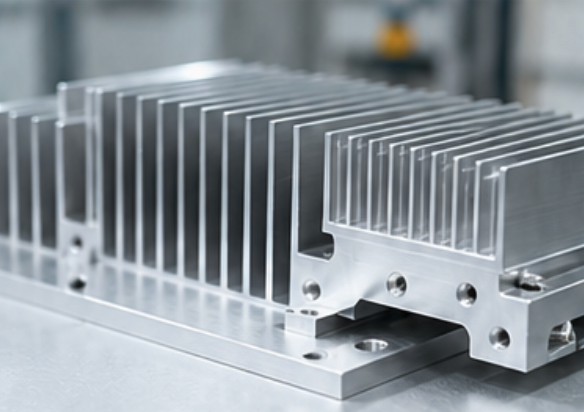
Reviewing present aluminum warmth sink extrusion profiles may help determine potential beginning geometries primarily based on width, total peak, and base thickness.
An present extrusion can usually be lower to the required size and additional personalized by means of CNC machining.
Mounting holes, threaded options, slots, pockets, and clearance areas could be added in accordance with the mechanical design.
This method could scale back tooling necessities and growth time in contrast with creating a very new extrusion die.
Nonetheless, the present cross-section nonetheless must be checked towards the thermal design. Matching the accessible house doesn’t set up {that a} profile gives adequate cooling.
If the required fin association or base geometry differs considerably from accessible profiles, customized tooling or one other manufacturing methodology could be the extra acceptable selection.
Validate the whole meeting underneath sensible circumstances
Thermal simulation and part specs are beneficial design instruments, however prototype testing stays vital.
A warmth sink that meets a calculated thermal-resistance goal should still carry out otherwise when put in beside different heat-generating elements.
For robotic gear, helpful validation circumstances embrace:
- Most anticipated working temperature contained in the enclosure
- Consultant movement and motor-loading cycles
- Sustained high-duty operation
- Regular and lowered cooling airflow
- Warmth generated by neighboring digital assemblies
- Precise mounting {hardware} and thermal interface supplies
Temperature measurements needs to be taken at related part areas, with explicit consideration to the connection between the measured factors and the semiconductor junction temperatures that should stay inside specification.
The place attainable, testing ought to use the supposed manufacturing meeting relatively than a loosely mounted laboratory configuration.
Vibration, thermal biking, and mechanical loading might also must be thought-about when evaluating long-term interface stability.
Deliver thermal and manufacturing groups into the design course of earlier
Thermal administration turns into tougher and costly to alter as soon as the enclosure dimensions, PCB association, and mounting options are mounted.
Early communication between electronics engineers, mechanical designers, and warmth sink producers may help determine limitations earlier than tooling and manufacturing commitments are made.
For a helpful manufacturing assessment, the venture group ought to present the estimated warmth dissipation, cooling setting, accessible dimensions, mounting structure, required floor tolerances, materials preferences, and anticipated manufacturing amount.
These particulars assist decide whether or not an present extrusion, a customized warmth sink, or a unique cooling structure is suitable.
The target will not be merely to fabricate a metallic part that matches the drawing. It’s to supply a repeatable cooling answer that works with the whole digital and mechanical meeting.
Thermal reliability begins with sensible design selections
As industrial robots develop into extra compact and electronics-intensive, efficient thermal administration requires nearer consideration to the connection between energy losses, airflow, mechanical interfaces, and manufacturing processes.
The simplest answer will not be essentially the warmth sink with the biggest variety of fins or probably the most sophisticated development.
It’s the answer that maintains acceptable part temperatures underneath sensible working circumstances whereas assembly the gear’s house, weight, reliability, and manufacturing necessities.
For robotic builders and automation system integrators, addressing these particulars early may help forestall thermal issues from changing into expensive redesigns later in growth.
Fundamental picture: An industrial robotic beside a power-electronics management cupboard.