Thermal administration parts should transfer warmth away from energy electronics whereas sustaining the mechanical relationships required for meeting.
Warmth sinks, cooling plates, inverter housings, and comparable components can comprise fins, deep cooling holes, fluid passages, and managed contact surfaces. For CNC milling parts, dimensional errors can alter circulate paths, mounting alignment, fin geometry, or thermal contact.
Thermal Administration Begins with Correct Mechanical Options Every half that’s being cooled is a part of a higher mechanical/thermal setting.
In an effort to present satisfactory warmth switch, a warmth sink must have good solid-to-solid contact with a warmth producing part, the mounting holes on the warmth sink have to line up with the housing it is going to be put in in, and the cooling passages have to be positioned and sized as required to ensure that coolant to succeed in the specified space.
In CNC machining services, these mechanical options should be examined by their purposeful capability. Gaps shaped on the interface of the warmth sink with the warmth supply might create extra thermal resistance; misaligned or improperly positioned mounting holes could trigger meeting stresses; and variations from the specs within the measurement of the cooling passages might alter fluid circulate and stress drop.
WayKen’s traction inverter housing represents a sensible utility. The aluminum 6061 housing has exterior heat-sink fins and incorporates an inside pocket with two 11mm diameter x 106mm deep cooling holes.
Coolant flows into one finish of every gap, flows by means of the inside passage eradicating warmth from the traction inverter, then leaves out of the other finish.
WayKen utilized liquid cooling utilizing its spindle to provide coolant on to the deep holes which helped preserve decrease temperatures and take away machining particles. There have been over fifty GD & T necessities referenced all through the seven datum reference planes contained within the housing.
Machining Fins Circulation Channels and Thermal Contact Surfaces
Fins enhance floor space, however their thickness, spacing, and peak should stay constant sufficient for predictable warmth dissipation. Deep channels and holes create extra challenges as a result of software attain, chip evacuation, and coolant supply turn into troublesome as depth will increase.
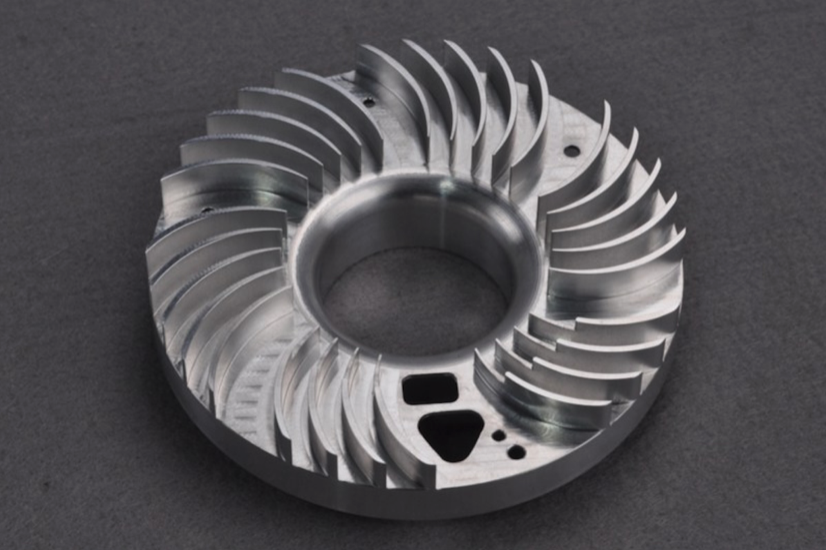
WayKen’s industrial turbine heatsink venture concerned machining a big aluminum heatsink with a dense fin construction. The half was roughly 400 mm lengthy, 200 mm broad, and 80 mm excessive, with fins as skinny as 1 mm.
The heatsink additionally required H7 bores for bearing and shaft meeting. Its fins measured solely 0.48–1.1 mm thick, so WayKen adjusted toolpath parameters repeatedly to forestall breakage and deformation.
For CNC milling components, roughing and ending ought to be separated the place delicate options are concerned. Bulk materials could be eliminated aggressively, leaving managed inventory for ending. Smaller instruments and lighter passes can then set up remaining geometry. Thermal contact surfaces deserve specific consideration.
Flatness and floor end have an effect on the world by means of which warmth passes right into a cooler or warmth sink. Burrs, software marks, or extreme roughness can create gaps that enhance thermal resistance.
How WayKen Balances Warmth Dissipation Precision and Manufacturability
There could also be each delicate options concerned in warmth switch and stiff areas wanted for fastening when designing thermal parts. Thus, correct tooling, reduce instructions, work holding, and machining order should have in mind these contradicting necessities.
When selecting CNC machining for the traction inverter case research, WayKen took into consideration not solely machine capabilities but in addition machining effectivity and price as nicely.
CNC machining providers are extra easy and environment friendly if the machine is ready to attain all required options with out including pointless complexity to the design.
WayKen machined the inverter housing in a single setup the place it was potential, utilizing datums to protect relationships between the options. In any other case, already machined datums or holes had been used as references.
WayKen used CNC mill-turn machining in case of the turbine heatsink as a result of its many fins might be machined through milling whereas the high-quality holes wanted turning to offer accuracy and concentricity. The 2 important bores had been machined with tolerance H7 whereas 2 mm holes had been reamed.
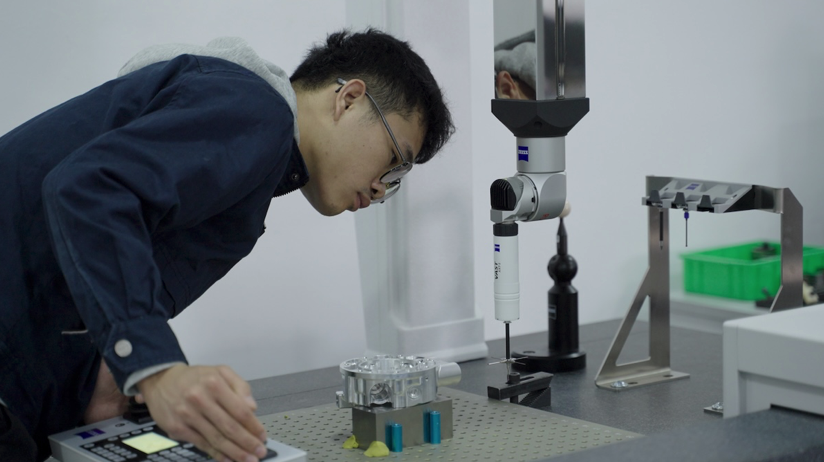
Inspection got here subsequent in WayKen course of. The corporate used Zeiss CMM machines to measure all of the GD&T necessities of the inverter housing and supplied the pattern components together with a first-article inspection report.
In case of CNC milling components, inspection ought to concentrate on thermal contact surfaces, fin geometry, cooling gap sizes, mounting options, and datums.
Conclusion
Thermal administration parts require manufacturing choices that help each warmth switch and mechanical meeting. Fin geometry, cooling-hole dimensions, floor situation, datum relationships, and contact-surface accuracy can all have an effect on efficiency.
The WayKen examples present how machining technique, coolant supply, managed setups, mill-turn processing, and CMM inspection handle these necessities.
When CNC machining providers deal with thermal and mechanical options as one system, cooling parts can stay purposeful, manufacturable, and persistently dependable throughout demanding low-volume manufacturing tasks.